What is a peptide? The amino acid chains behind insulin, oxytocin and Ozempic
Published
Insulin was first isolated in 1921 (opens in a new tab). More than a century later, most people who use it still inject it. The reason is that your digestive system is extremely good at its job.
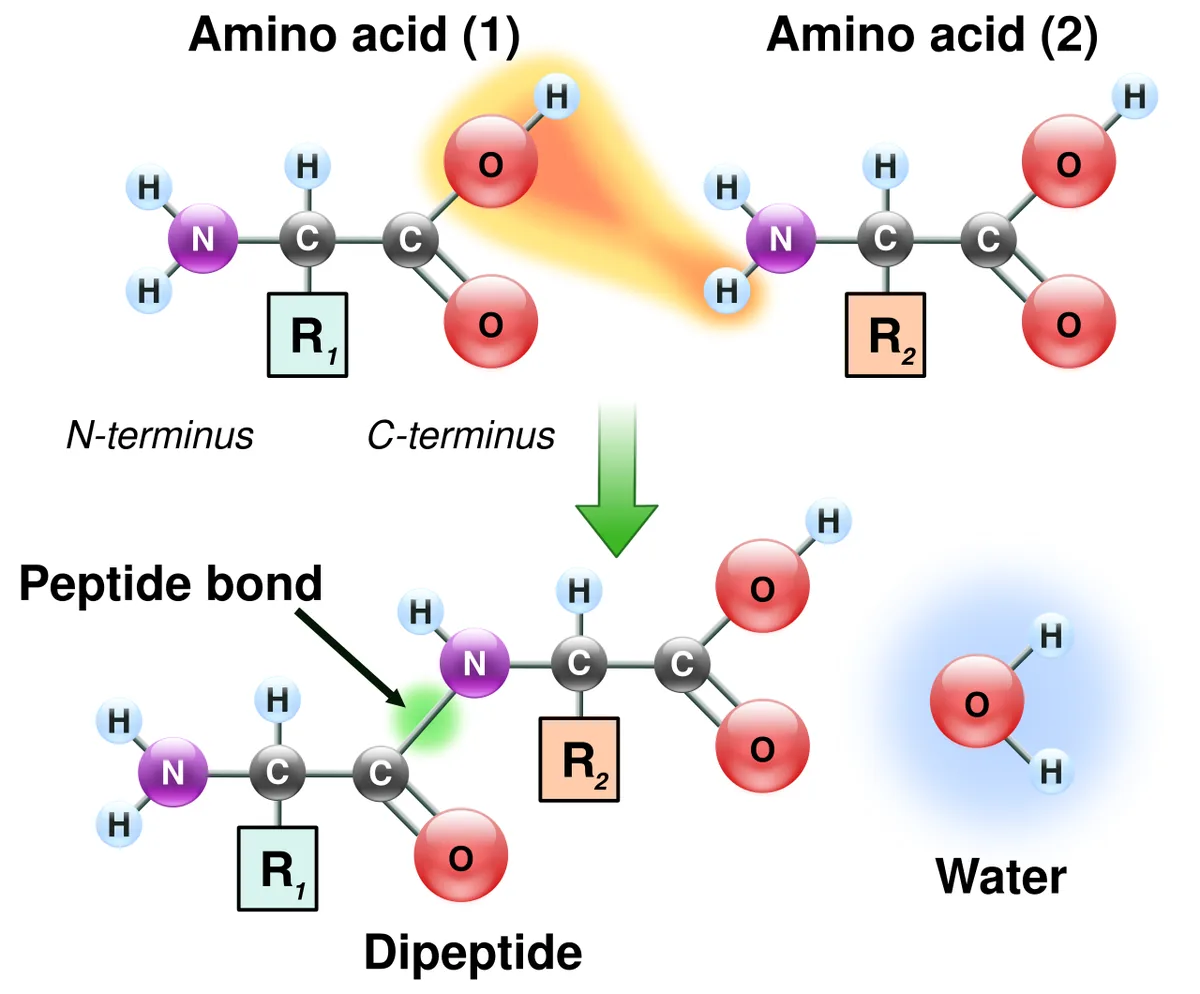
Every time you eat a piece of chicken or a bowl of lentils, your stomach and intestines take the protein in it apart, chain by chain, into single amino acids and fragments just two or three long (opens in a new tab). An unprotected insulin tablet would be broken down the same way. As one 2022 review of peptide drugs (opens in a new tab) puts it, peptides are easily broken down by digestive enzymes in the stomach and intestine, which is why most peptide drugs are given by injection.
The reason insulin gets digested is simple: a peptide is a short chain of amino acids, the same building blocks as the protein on your plate. That shared chemistry explains a surprising amount about peptides, including why they're tricky to turn into medicines.
An alphabet with twenty letters
How short? The National Human Genome Research Institute (opens in a new tab) puts it at typically 2 to 50 amino acids.
Amino acids are small molecules, and there are 20 common ones (opens in a new tab) in the proteins your body makes. A good way to picture them is as an alphabet. Twenty letters doesn't sound like much, but string them together in different orders and you can write almost anything. "Listen" and "silent" use the same six letters and mean completely different things. Peptides work the same way: the order of the amino acids, called the sequence, is what makes one peptide a hormone that lowers blood sugar and another a hormone that makes the uterus contract during labor.
The link between each pair of amino acids is called a peptide bond. When it forms, one amino acid hands over a hydrogen and an oxygen, the other hands over a hydrogen, and together they leave as a molecule of water (opens in a new tab). You can see it in the diagram above.
Here's the part that connects back to your stomach. Digestion runs that reaction in reverse. Your digestive enzymes push water back into the bond and snap the chain apart. Building a peptide releases water; digesting one uses water to undo it.
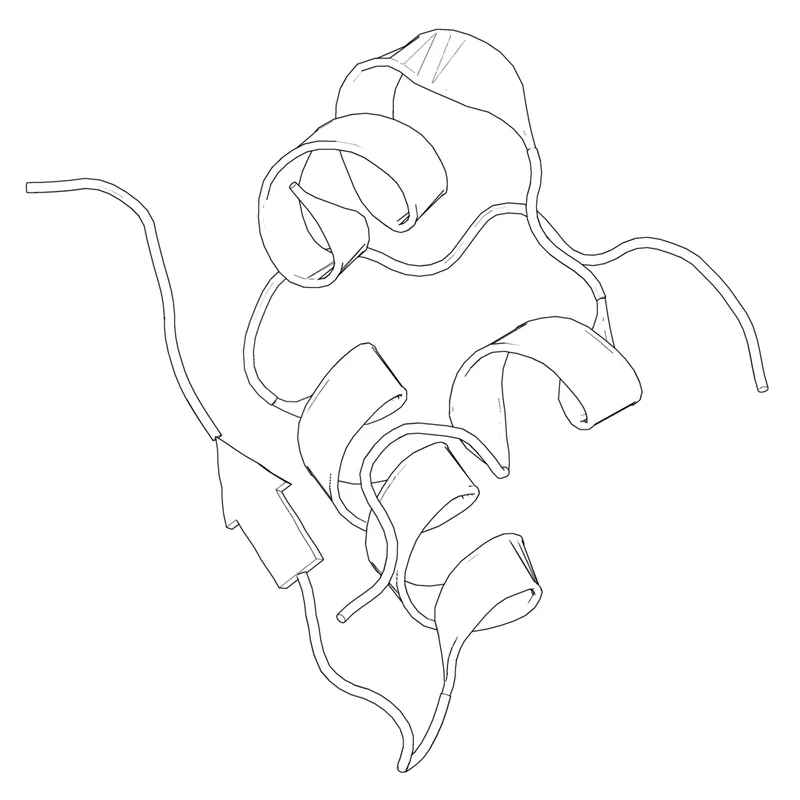
The alphabet comparison breaks down in one important place. Words sit flat on a page. Amino acid chains don't: they bend, coil and fold into three-dimensional shapes, and the shape is what lets a peptide do its job. The sequence decides the shape, so changing even one amino acid can change what the molecule does.
Where a peptide ends and a protein begins
Mostly, it's a matter of length, and the cutoffs are conventions rather than laws of nature. NHGRI calls a chain of 51 or more amino acids a polypeptide, and proteins are built from one or more polypeptides. A StatPearls chapter (opens in a new tab) draws the lines a little differently, using "polypeptide" for chains of 20 to 50.
Insulin shows how blurry the border is. It has 51 amino acids (opens in a new tab), split across two chains of 21 and 30 that are held together by chemical bridges. Depending on whom you ask, it's a large peptide or a small protein. Both are reasonable answers, and the label matters much less than what the molecule does.
Your body's short messages
Many of the peptides your body makes are signals. One cell releases them, they travel, and other cells respond.
The cells that respond have receptors, molecules on or in the cell that bind a specific substance and set off a specific effect (opens in a new tab). The usual comparison is a lock and key: only a peptide with the right shape fits the receptor well enough to turn it. That picture is a simplification, since real binding is less all-or-nothing than a key in a lock, but it explains something important. A peptide doesn't act everywhere in the body. It acts where its receptors are.
Oxytocin is a good example of how little it takes. It's a peptide of just nine amino acids (opens in a new tab), released from the back of the pituitary gland, a pea-sized gland at the base of the brain, and it causes the uterus to contract during labor and milk to flow during breastfeeding.
Insulin is a longer message with a bigger job. After you eat, sugar from your food enters your blood as glucose. Your cells need that glucose for energy, but it can't simply walk in. Insulin, made by the pancreas, helps glucose get into your cells (opens in a new tab), and it also tells the body to hold back the sugar it makes on its own (opens in a new tab). Without enough insulin, the NIDDK explains, glucose stays in the blood and doesn't reach the cells: blood sugar rises while the cells that need the fuel go short. In type 1 diabetes, the immune system destroys the cells that make insulin, and people with type 1 diabetes need to take insulin every day to stay alive.
GLP-1: how a two-minute hormone became a once-a-week drug
The most talked-about peptide right now is probably GLP-1, short for glucagon-like peptide-1. Your gut releases it after a meal (opens in a new tab). When blood sugar is high, it helps the pancreas release insulin and holds back glucagon (opens in a new tab), a hormone that raises blood sugar. It also acts on areas of the brain involved in appetite (opens in a new tab).
Natural GLP-1 has a problem as a medicine, though. It barely lasts. Its half-life, the time it takes for half of it to be cleared, is around one to two minutes (opens in a new tab): an enzyme called DPP-4 cuts it apart, and the kidneys clear it. That makes sense for a signal that should fade once a meal is over. It makes no sense for a drug you'd need to inject constantly.
Semaglutide, the medicine in Ozempic and Wegovy, gets around that with a few deliberate edits. It shares 94% of its sequence (opens in a new tab) with human GLP-1. According to its label, one amino acid near the start is changed to protect it from being broken down, and a fatty acid chain (a small fat-like tail) is attached that makes the molecule cling to albumin, a protein your blood carries in large amounts and keeps for several weeks (opens in a new tab). Riding along with albumin, semaglutide stays in circulation far longer than the natural hormone. The result is a half-life of about one week.
That's modern peptide drug design in miniature: start with a message the body already understands, then edit it so it lasts long enough to be useful. By 2022, more than 80 peptide drugs (opens in a new tab) had been approved worldwide, according to one review.
So why the needle?
Because digestion breaks peptides down, most peptide medicines skip the digestive tract altogether and are given by injection. Everyday insulin injections and injectable semaglutide go in as a subcutaneous injection, into the fatty layer just under the skin, where the drug is absorbed into small blood vessels. In hospitals, insulin can also go into a vein, and other peptide medicines are injected into a vein or a muscle. The Merck Manual (opens in a new tab) notes that this route is used for protein drugs that would be destroyed in the digestive tract if swallowed.
There are exceptions, and they show how hard the problem is. An oral form of semaglutide exists, but only because it's formulated with an ingredient called SNAC (opens in a new tab), which helps it survive the stomach and get absorbed through the stomach wall.
The same chemistry explains the "peptides" on supplement labels. Collagen peptides are collagen that has already been cut into smaller pieces, and once swallowed they meet the same enzymes as the chicken and lentils: collagen is broken down into amino acids (opens in a new tab), which the body uses wherever it needs protein. Some randomized trials have reported better skin elasticity, but Harvard's Nutrition Source notes that most if not all of the research on collagen supplements is funded at least partly by related industries.
Some peptide products also come as a freeze-dried powder, because they can be unstable in liquid (opens in a new tab), and the powder has to be dissolved again before use. That step, reconstitution, is where the arithmetic begins: the amount of peptide in the vial stays the same, but the volume of liquid you add decides how much of it is in every unit on the syringe. Our peptide reconstitution calculator and BAC water calculator handle that math. They don't tell you what dose to use, which liquid to add or how long a mixed vial keeps; those have to come from your prescriber and the product's instructions.
"Peptide" describes a molecule, not a safety record
Because the word describes a molecule's structure, it covers an enormous range of products. Insulin, oxytocin and semaglutide are FDA-approved medicines, with official labels that list their uses, risks and warnings. At the other end are injectable peptides sold online. PolitiFact's review, republished by PBS NewsHour (opens in a new tab), notes that compounds such as BPC-157 and TB-500 are promoted for muscle and tissue healing, that most of the safety and efficacy evidence for them comes from studies in animals rather than people, and that their long-term risks are unknown.
Two labels are worth recognizing. A compounded drug is prepared by a licensed pharmacist or physician, often for one patient's needs, or by an outsourcing facility. It isn't FDA-approved, and the FDA doesn't check (opens in a new tab) its safety, effectiveness or quality before it's sold. A product marked "research use only" or "not for human consumption" isn't meant for people at all, and the FDA has warned (opens in a new tab) that some products sold to the public carry those labels falsely.
The rules where those two labels meet are shifting. In October 2026, HHS published a draft, interim policy (opens in a new tab) saying it does not intend to take enforcement action against state-licensed pharmacies, federal facilities and licensed physicians that compound six peptides, including BPC-157 and TB-500, if they meet a list of conditions (opens in a new tab), among them a patient-specific prescription and ingredients that aren't "research use only" material. As of November 2026, it's a decision not to enforce, not an approval, and HHS says it may revisit it if a safety or quality problem arises.
None of this means every unfamiliar peptide is dangerous. It means the word itself tells you nothing about whether a product has been tested in people, what's actually in the vial, or what amount is appropriate. Those answers come from an approved label, a prescriber and a pharmacist.
What the word does and doesn't tell you
Sequence decides shape, and shape decides which receptors a peptide can switch on. That's why a chain of nine amino acids and a chain of 51 can do jobs as different as labor and blood sugar, and why a few edits and a fatty tail can stretch a two-minute signal into a week.
And because peptides are built from the same material as food, most of these medicines still come with a needle. The word "peptide" on a label describes chemistry, not a promise. The next time you see it, the useful questions are the ones underneath: which peptide, approved for what, and who decided the dose.